Recursive descent and Pratt parser for the Zura language. More...
#include <stddef.h>#include "../ast/ast.h"#include "../c_libs/memory/memory.h"#include "../helper/help.h"#include "../lexer/lexer.h"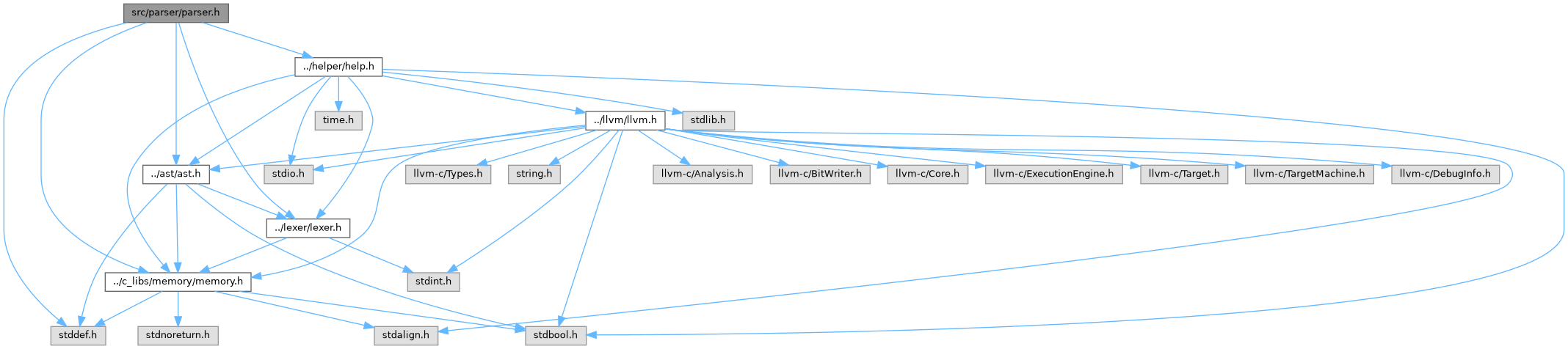

Go to the source code of this file.
Classes | |
| struct | Parser |
| Parser state holding token stream and current position. More... | |
Macros | |
| #define | CURRENT_TOKEN_LENGTH(parser) ((int)p_current(parser).length) |
| Get the length of the current token's lexeme. | |
| #define | CURRENT_TOKEN_VALUE(parser) (p_current(parser).value) |
| Get the value string of the current token. | |
| #define | MAX_STMT 1024 |
| Maximum allowed size for statements, expressions, and types. | |
| #define | MAX_EXPR 1024 |
| #define | MAX_TYPE 1024 |
Enumerations | |
| enum | BindingPower { BP_NONE = 0 , BP_LOWEST , BP_ASSIGN , BP_TERNARY , BP_LOGICAL_OR , BP_LOGICAL_AND , BP_BITWISE_OR , BP_BITWISE_XOR , BP_BITWISE_AND , BP_EQUALITY , BP_RELATIONAL , BP_RANGE , BP_SHIFT , BP_SUM , BP_PRODUCT , BP_EXPONENT , BP_UNARY , BP_POSTFIX , BP_CALL , BP_PRIMARY } |
| Binding power (precedence) levels for expression parsing. More... | |
Functions | |
| void | parser_error (Parser *psr, const char *error_type, const char *file, const char *msg, int line, int col, int tk_length) |
| Report a parser error with detailed location info. | |
| char * | collect_doc_comments (Parser *parser) |
| Collects consecutive documentation comments before a declaration. | |
| void | consume_doc_comments (Parser *parser) |
| bool | p_has_tokens (Parser *psr) |
| Checks if there are more tokens available for parsing. | |
| Token | p_peek (Parser *psr, size_t offset) |
| Peeks at a token at the specified offset from current position. | |
| Token | p_current (Parser *psr) |
| Gets the current token without advancing the parser position. | |
| Token | p_advance (Parser *psr) |
| Advances to the next token and returns the current token. | |
| Token | p_consume (Parser *psr, LumaTokenType type, const char *error_msg) |
| Consumes a token of the expected type or reports an error. | |
| char * | get_name (Parser *psr) |
| Extracts and duplicates the current token's string value. | |
| Stmt * | parse (GrowableArray *tks, ArenaAllocator *arena, BuildConfig *config) |
| Parses a full program from tokens into an AST of statements. | |
| Expr * | parse_expr (Parser *parser, BindingPower bp) |
| Parses an expression using the Pratt parsing algorithm. | |
| Stmt * | parse_stmt (Parser *parser) |
| Parses a single statement. | |
| Type * | parse_type (Parser *parser) |
| Parses a type annotation. | |
| bool | init_parser_arrays (Parser *parser, GrowableArray *stmts, GrowableArray *modules) |
| const char * | parse_module_declaration (Parser *parser, char **out_module_doc) |
| Expr * | nud (Parser *parser) |
| Null Denotation - handles prefix expressions and primary expressions. | |
| Expr * | led (Parser *parser, Expr *left, BindingPower bp) |
| Pratt parser function for left denotation (infix/postfix parsing). | |
| BindingPower | get_bp (LumaTokenType kind) |
| Gets the binding power (precedence) for a given token type. | |
| Expr * | primary (Parser *parser) |
| Expr * | unary (Parser *parser) |
| Expr * | grouping (Parser *parser) |
| Expr * | binary (Parser *parser, Expr *left, BindingPower bp) |
| Expr * | call_expr (Parser *parser, Expr *left, BindingPower bp) |
| Expr * | assign_expr (Parser *parser, Expr *left, BindingPower bp) |
| Expr * | prefix_expr (Parser *parser, Expr *left, BindingPower bp) |
| Expr * | array_expr (Parser *parser) |
| Expr * | index_expr (Parser *parser) |
| Expr * | deref_expr (Parser *parser) |
| Expr * | addr_expr (Parser *parser) |
| Expr * | alloc_expr (Parser *parser) |
| Expr * | free_expr (Parser *parser) |
| Expr * | cast_expr (Parser *parser) |
| Expr * | input_expr (Parser *parser) |
| Expr * | system_expr (Parser *parser) |
| Expr * | syscall_expr (Parser *parser) |
| Expr * | sizeof_expr (Parser *parser) |
| Expr * | struct_expr (Parser *parser) |
| Expr * | named_struct_expr (Parser *parser, Expr *left, BindingPower bp) |
| Type * | tnud (Parser *parser) |
| Type * | tled (Parser *parser, Type *left, BindingPower bp) |
| BindingPower | tget_bp (Parser *parser, LumaTokenType kind) |
| Type * | pointer (Parser *parser) |
| Type * | array_type (Parser *parser) |
| Type * | function_type (Parser *parser, Type *return_type) |
| Stmt * | use_stmt (Parser *parser) |
| Stmt * | os_stmt (Parser *parser) |
| Stmt * | link_stmt (Parser *parser) |
| Stmt * | expr_stmt (Parser *parser) |
| Parses an expression statement. | |
| Stmt * | var_stmt (Parser *parser, bool is_public) |
| Parses a variable declaration statement. | |
| Stmt * | const_stmt (Parser *parser, bool is_public, bool returns_ownership, bool takes_ownership) |
| Parses a constant declaration statement. | |
| Stmt * | fn_stmt (Parser *parser, const char *name, bool is_public, bool is_static, bool returns_ownership, bool takes_ownership) |
| Parses a function declaration statement. | |
| Stmt * | enum_stmt (Parser *parser, const char *name, bool is_public) |
| Parses an enumeration declaration statement. | |
| Stmt * | struct_stmt (Parser *parser, const char *name, bool is_public) |
| Parses a structure declaration statement. | |
| Stmt * | print_stmt (Parser *parser, bool ln) |
| Parses print/println statements. | |
| Stmt * | return_stmt (Parser *parser) |
| Parses a return statement. | |
| Stmt * | block_stmt (Parser *parser) |
| Parses a block statement. | |
| Stmt * | infinite_loop_stmt (Parser *parser, int line, int col) |
| Parses an infinite loop statement. | |
| Stmt * | for_loop_stmt (Parser *parser, int line, int col) |
| Parses a for loop statement. | |
| Stmt * | loop_stmt (Parser *parser) |
| Parses loop statements (infinite, while, or for loops) | |
| Stmt * | if_stmt (Parser *parser) |
| Parses if/elif/else conditional statements. | |
| Stmt * | break_continue_stmt (Parser *parser, bool is_continue) |
| Parses break and continue statements. | |
| Stmt * | defer_stmt (Parser *parser) |
| Stmt * | switch_stmt (Parser *parser) |
| Stmt * | impl_stmt (Parser *parser) |
Detailed Description
Recursive descent and Pratt parser for the Zura language.
This module implements parsing of tokens into an Abstract Syntax Tree (AST), handling expressions, statements, types, and error reporting. The parser uses binding power (precedence) to correctly parse expressions.
The parser supports:
- Parsing expressions with Pratt parsing techniques (nud/led functions).
- Parsing statements including variable declarations, functions, loops, etc.
- Parsing types including pointers and arrays.
- Error reporting with detailed location info.
- Date
- 2025
Macro Definition Documentation
◆ CURRENT_TOKEN_LENGTH
| #define CURRENT_TOKEN_LENGTH | ( | parser | ) | ((int)p_current(parser).length) |
Get the length of the current token's lexeme.
◆ CURRENT_TOKEN_VALUE
| #define CURRENT_TOKEN_VALUE | ( | parser | ) | (p_current(parser).value) |
Get the value string of the current token.
◆ MAX_EXPR
| #define MAX_EXPR 1024 |
◆ MAX_STMT
| #define MAX_STMT 1024 |
Maximum allowed size for statements, expressions, and types.
◆ MAX_TYPE
| #define MAX_TYPE 1024 |
Enumeration Type Documentation
◆ BindingPower
| enum BindingPower |
Binding power (precedence) levels for expression parsing.
Used to control operator precedence and associativity in Pratt parsing.
Function Documentation
◆ addr_expr()
◆ alloc_expr()
◆ array_expr()
◆ array_type()
◆ assign_expr()
| Expr * assign_expr | ( | Parser * | parser, |
| Expr * | left, | ||
| BindingPower | bp | ||
| ) |
◆ binary()
| Expr * binary | ( | Parser * | parser, |
| Expr * | left, | ||
| BindingPower | bp | ||
| ) |
◆ block_stmt()
Parses a block statement.
Handles block statements with the syntax: { statement1; statement2; ... }
- Parameters
-
parser Pointer to the parser instance
- Returns
- Pointer to the block statement AST node, or NULL on failure
- Note
- Empty blocks are allowed and create a valid block statement with 0 statements
- Each statement in the block is parsed recursively using parse_stmt()
- Handles memory allocation for the statement array using growable arrays
- Continues parsing on individual statement failures (for error recovery)
- See also
- parse_stmt(), create_block_stmt()
◆ break_continue_stmt()
Parses break and continue statements.
Handles loop control statements with the syntax:
break;- Exit the current loopcontinue;- Skip to the next iteration of the current loop
- Parameters
-
parser Pointer to the parser instance is_continue Whether this is a continue (true) or break (false) statement
- Returns
- Pointer to the break/continue statement AST node, or NULL on failure
- Note
- Both statements require semicolon terminators
- These statements are only valid within loop contexts (enforced at semantic analysis)
- Break exits the innermost enclosing loop
- Continue skips to the next iteration of the innermost enclosing loop
- See also
- create_break_continue_stmt()
◆ call_expr()
| Expr * call_expr | ( | Parser * | parser, |
| Expr * | left, | ||
| BindingPower | bp | ||
| ) |
◆ cast_expr()
◆ collect_doc_comments()
| char * collect_doc_comments | ( | Parser * | parser | ) |
Collects consecutive documentation comments before a declaration.
Accumulates all doc comments (/// or //!) that appear immediately before the current token. Returns them as a single string with newlines preserved.
- Parameters
-
parser Pointer to the parser instance
- Returns
- Concatenated doc comment string, or NULL if no doc comments found
◆ const_stmt()
Parses a constant declaration statement.
Handles multiple forms of constant declarations:
const name: Type = value;- Explicit type annotationconst name = fn ...- Function declarationconst name = struct ...- Struct declarationconst name = enum ...- Enum declaration
- Parameters
-
parser Pointer to the parser instance is_public Whether this declaration has public visibility
- Returns
- Pointer to the appropriate declaration statement AST node, or NULL on failure
- Note
- For simple constants, creates a variable declaration with immutable flag
- For complex types (functions, structs, enums), delegates to specialized parsers
- If no type is specified, it defaults to the type of the value
- See also
- fn_stmt(), struct_stmt(), enum_stmt(), create_var_decl_stmt()
◆ consume_doc_comments()
| void consume_doc_comments | ( | Parser * | parser | ) |
◆ defer_stmt()
◆ deref_expr()
◆ enum_stmt()
Parses an enumeration declaration statement.
Handles enum declarations with the syntax: enum { member1, member2, member3, ... };
- Parameters
-
parser Pointer to the parser instance name Enum name (already parsed by caller) is_public Whether this enum has public visibility
- Returns
- Pointer to the enum declaration AST node, or NULL on failure
- Note
- Enum members are identifiers separated by commas
- Trailing commas are allowed but not required
- Requires a semicolon terminator after the closing brace
- See also
- create_enum_decl_stmt()
◆ expr_stmt()
Parses an expression statement.
An expression statement consists of any expression followed by a semicolon. This is used for statements that evaluate an expression for its side effects, such as function calls or assignment expressions.
- Parameters
-
parser Pointer to the parser instance
- Returns
- Pointer to the created expression statement AST node, or NULL on failure
- Note
- Captures line and column information at the start of parsing
- Requires a semicolon terminator
- See also
- parse_expr(), create_expr_stmt()
◆ fn_stmt()
| Stmt * fn_stmt | ( | Parser * | parser, |
| const char * | name, | ||
| bool | is_public, | ||
| bool | is_static, | ||
| bool | returns_ownership, | ||
| bool | takes_ownership | ||
| ) |
Parses a function declaration statement.
Handles function declarations with the syntax: fn(param1: Type1, param2: Type2, ...) ReturnType { body }
- Parameters
-
parser Pointer to the parser instance name Function name (already parsed by caller) is_public Whether this function has public visibility
- Returns
- Pointer to the function declaration AST node, or NULL on failure
- Note
- Function parameters are stored as parallel arrays of names and types
- Return type is required and parsed after the parameter list
- Function body must be a block statement
- Memory for parameter arrays is allocated using the arena allocator
- See also
- parse_type(), block_stmt(), create_func_decl_stmt()
◆ for_loop_stmt()
Parses a for loop statement.
Handles for loops with the syntax:
- Parameters
-
parser Pointer to the parser instance line Line number where the loop statement starts col Column number where the loop statement starts
- Returns
- Pointer to the for loop statement AST node, or NULL on failure
- Note
- Supports multiple initializer variables separated by commas
- Main condition is required and parenthesized
- Optional secondary condition can be provided after a colon
- Loop body must be a block statement
◆ free_expr()
◆ function_type()
◆ get_bp()
| BindingPower get_bp | ( | LumaTokenType | kind | ) |
Gets the binding power (precedence) for a given token type.
This function is crucial for the Pratt parser implementation. It returns the binding power (precedence level) for different operators, which determines the order of operations during expression parsing.
Higher binding power values indicate higher precedence operators.
- Parameters
-
kind The token type to get binding power for
- Returns
- BindingPower enumeration value representing the precedence level Returns BP_NONE for tokens that don't have binding power
- Note
- Precedence levels (highest to lowest):
- BP_CALL: Function calls, member access, indexing
- BP_POSTFIX: Postfix increment/decrement
- BP_PRODUCT: Multiplication, division
- BP_SUM: Addition, subtraction
- BP_RELATIONAL: Comparison operators
- BP_EQUALITY: Equality and inequality
- BP_BITWISE_AND, BP_BITWISE_XOR, BP_BITWISE_OR: Bitwise operations
- BP_LOGICAL_AND, BP_LOGICAL_OR: Logical operations
- BP_TERNARY: Ternary conditional operator
- BP_ASSIGN: Assignment operators
- See also
- BindingPower, LumaTokenType
◆ get_name()
| char * get_name | ( | Parser * | psr | ) |
Extracts and duplicates the current token's string value.
This function creates a null-terminated string copy of the current token's value using the arena allocator. It's primarily used for extracting identifier names, string literals, and other textual token content that needs to be preserved in the AST.
- Parameters
-
psr Pointer to the parser instance
- Returns
- Pointer to a null-terminated string containing the current token's value, allocated using the parser's arena allocator
- Note
- The returned string is allocated using arena_alloc() for automatic memory management
- The string is properly null-terminated for safe use with standard string functions
- The original token value is copied, so the returned string is independent
- Memory is automatically managed by the arena - no manual deallocation needed
- Warning
- This function assumes the current token has a valid value field
- Should only be called when you know the current token contains string data
◆ grouping()
◆ if_stmt()
Parses if/elif/else conditional statements.
Handles complex conditional statements with multiple branches:
- Parameters
-
parser Pointer to the parser instance
- Returns
- Pointer to the if statement AST node, or NULL on failure
- Note
- Supports multiple elif clauses
- Else clause is optional
- Each condition must be parenthesized
- Each branch must be a block statement
- Elif statements are collected in an array rather than nested recursively
- See also
- parse_expr(), block_stmt(), create_if_stmt()
◆ impl_stmt()
◆ index_expr()
◆ infinite_loop_stmt()
Parses an infinite loop statement.
Handles infinite loops with the syntax: loop { ... }
- Parameters
-
parser Pointer to the parser instance line Line number where the loop statement starts col Column number where the loop statement starts
- Returns
- Pointer to the infinite loop statement AST node, or NULL on failure
- Note
- The loop body must be a block statement
- This creates a loop that runs indefinitely unless broken by break/return
- See also
- block_stmt(), create_infinite_loop_stmt()
◆ init_parser_arrays()
| bool init_parser_arrays | ( | Parser * | parser, |
| GrowableArray * | stmts, | ||
| GrowableArray * | modules | ||
| ) |
◆ input_expr()
◆ led()
| Expr * led | ( | Parser * | parser, |
| Expr * | left, | ||
| BindingPower | bp | ||
| ) |
Pratt parser function for left denotation (infix/postfix parsing).
- Parameters
-
parser Parser pointer. left Left expression. bp Binding power.
- Returns
- Parsed expression node.
Pratt parser function for left denotation (infix/postfix parsing).
This is part of the Pratt parser implementation. The "led" function handles tokens that can appear after an expression has been parsed (binary operators and postfix operators).
- Parameters
-
parser Pointer to the parser instance left The left operand expression (already parsed) bp The current binding power context
- Returns
- Pointer to the parsed expression AST node incorporating the left operand, or the original left expression if no valid LED is found
- Note
- Handles:
- Binary arithmetic and logical operators: +, -, *, /, ==, !=, etc.
- Function calls: function(args)
- Assignment: variable = value
- Member access: object.member
- Postfix operators: variable++, variable–
- Array indexing: array[index]
- See also
- nud(), parse_expr(), binary(), call_expr(), assign_expr(), prefix_expr()
◆ link_stmt()
◆ loop_stmt()
Parses loop statements (infinite, while, or for loops)
Dispatcher function that determines the type of loop based on the following tokens and delegates to the appropriate specialized parser:
loop { ... }→ infinite looploop [initializers](...) { ... }→ for looploop (condition) { ... }→ while looploop (condition) : (optional_condition) { ... }→ while loop with secondary condition
- Parameters
-
parser Pointer to the parser instance
- Returns
- Pointer to the appropriate loop statement AST node, or NULL on failure
- Note
- The specific loop type is determined by the token following 'loop'
- All loop bodies must be block statements
◆ named_struct_expr()
| Expr * named_struct_expr | ( | Parser * | parser, |
| Expr * | left, | ||
| BindingPower | bp | ||
| ) |
◆ nud()
Null Denotation - handles prefix expressions and primary expressions.
This is part of the Pratt parser implementation. The "nud" function handles tokens that can appear at the beginning of an expression (prefix operators and primary expressions like literals and identifiers).
- Parameters
-
parser Pointer to the parser instance
- Returns
- Pointer to the parsed expression AST node, or NULL if parsing fails
- Note
- Handles:
- Primary expressions: numbers, strings, identifiers
- Prefix unary operators: -, +, !, ++, –
- Grouped expressions: (expression)
- Array literals: [expression, ...]
- See also
- led(), parse_expr(), primary(), unary(), grouping(), array_expr()
◆ os_stmt()
◆ p_advance()
Advances to the next token and returns the current token.
This function moves the parser position forward by one token and returns the token that was current before advancing. This is the primary mechanism for consuming tokens during parsing.
- Parameters
-
psr Pointer to the parser instance
- Returns
- The token that was current before advancing, or EOF token if already at the end of the token stream
- Note
- The parser position is incremented only if there are tokens available
- Safe to call at end of stream - returns EOF token and doesn't advance
- This is a mutating operation that changes parser state
- Warning
- After calling this function, subsequent calls to p_current() will return the next token in the stream
- See also
- p_current(), p_has_tokens(), p_consume()
◆ p_consume()
| Token p_consume | ( | Parser * | psr, |
| LumaTokenType | type, | ||
| const char * | error_msg | ||
| ) |
Consumes a token of the expected type or reports an error.
This function is used when the parser expects a specific token type at the current position. If the current token matches the expected type, it advances and returns the token. If not, it reports a syntax error with the provided error message.
- Parameters
-
psr Pointer to the parser instance type The expected token type that should be at the current position error_msg Error message to display if the token doesn't match
- Returns
- The consumed token if it matches the expected type, or an EOF token if there's a mismatch (indicating an error)
- Note
- This function combines token validation and consumption in one operation
- Error reporting includes current line, column, and token length information
- The parser position advances only on successful token match
- On error, the parser position remains unchanged
- Warning
- Always check the return value's type if you need to handle parsing errors
- See also
- p_current(), p_advance(), parser_error(), LumaTokenType
◆ p_current()
Gets the current token without advancing the parser position.
This function returns the token at the current parser position without modifying the parser state. It's the most frequently used function for examining the current token during parsing.
- Parameters
-
psr Pointer to the parser instance
- Returns
- Current token, or an EOF token if at the end of the token stream
- Note
- This function is safe to call even when at the end of the token stream
- The returned token contains all token information: type, value, position, etc.
- Does not modify parser state - can be called multiple times safely
- See also
- p_advance(), p_peek(), Token
◆ p_has_tokens()
| bool p_has_tokens | ( | Parser * | psr | ) |
Checks if there are more tokens available for parsing.
This function determines whether the parser has reached the end of the token stream. It's used throughout the parser to control parsing loops and prevent buffer overruns when accessing tokens.
- Parameters
-
psr Pointer to the parser instance
- Returns
- true if there are more tokens to process (and current token is not EOF), false if at end of stream or current token is EOF
- Note
- This function performs two checks:
- Position is within the token array bounds
- Current token is not TOK_EOF (which marks end of input)
- See also
- p_current(), p_advance()
◆ p_peek()
Peeks at a token at the specified offset from current position.
This function allows looking ahead in the token stream without advancing the current position. It's useful for making parsing decisions based on upcoming tokens (lookahead parsing).
- Parameters
-
psr Pointer to the parser instance offset Number of positions ahead to look (0 = current, 1 = next, etc.)
- Returns
- Token at the specified offset, or an EOF token if the offset goes beyond the end of the token stream
- Note
- Common usage patterns:
p_peek(parser, 0)is equivalent top_current(parser)p_peek(parser, 1)looks at the next token- Safe to use with any offset; returns EOF token for out-of-bounds access
- See also
- p_current(), Token, TOK_EOF
◆ parse()
| Stmt * parse | ( | GrowableArray * | tks, |
| ArenaAllocator * | arena, | ||
| BuildConfig * | config | ||
| ) |
Parses a full program from tokens into an AST of statements.
- Parameters
-
tks GrowableArray containing tokens. arena Memory arena for allocations.
- Returns
- Pointer to the root AST statement node (program).
Parses a full program from tokens into an AST of statements.
This is the entry point for the parser. It takes a growable array of tokens and converts them into a complete program AST node containing all parsed statements.
- Parameters
-
tks Growable array containing all tokens from the lexer arena Arena allocator for memory management during parsing
- Returns
- Pointer to the root AST node (Program node) containing all parsed statements, or NULL if parsing fails
- Note
- The function estimates the initial capacity for statements based on token count
- All memory allocations use the provided arena allocator
- See also
- Parser, parse_stmt(), create_program_node()
Main parsing function that converts tokens into an AST
This is the entry point for the parser. It takes a growable array of tokens and converts them into a complete program AST node containing all parsed statements.
◆ parse_expr()
| Expr * parse_expr | ( | Parser * | parser, |
| BindingPower | bp | ||
| ) |
Parses an expression using the Pratt parsing algorithm.
This is the core expression parsing function that implements the Pratt parser algorithm. It handles operator precedence and associativity automatically through the binding power mechanism.
- Parameters
-
parser Pointer to the parser instance bp Minimum binding power - only operators with higher binding power will be consumed by this call
- Returns
- Pointer to the parsed expression AST node, or NULL if parsing fails
- Note
- The algorithm works by:
- See also
- nud(), led(), get_bp(), BindingPower
◆ parse_module_declaration()
| const char * parse_module_declaration | ( | Parser * | parser, |
| char ** | out_module_doc | ||
| ) |
◆ parse_stmt()
Parses a single statement.
This function dispatches to the appropriate statement parsing function based on the current token. It also handles visibility modifiers (public/private) that can appear before certain statement types.
- Parameters
-
parser Pointer to the parser instance
- Returns
- Pointer to the parsed statement AST node, or NULL if parsing fails
- Note
- Handles:
- Variable declarations: const, var
- Control flow: return, if, loop, break, continue
- Block statements: { ... }
- Print statements: print, println
- Expression statements: any expression followed by semicolon
- Visibility modifiers: public, private (applied to declarations)
◆ parse_type()
Parses a type annotation.
This function parses type expressions used in variable declarations, function parameters, return types, etc. It handles primitive types, pointer types, array types, and user-defined types.
- Parameters
-
parser Pointer to the parser instance
- Returns
- Pointer to the parsed Type AST node, or NULL if parsing fails
- Note
- Handles:
- Primitive types: int, uint, float, bool, string, void, char
- Pointer types: *type
- Array types: [size]type or []type
- User-defined types: identified by TOK_IDENTIFIER
- Warning
- Prints error message to stderr for unexpected tokens
- See also
- tnud(), tled(), LumaTokenType
◆ parser_error()
| void parser_error | ( | Parser * | psr, |
| const char * | error_type, | ||
| const char * | file, | ||
| const char * | msg, | ||
| int | line, | ||
| int | col, | ||
| int | tk_length | ||
| ) |
Report a parser error with detailed location info.
- Parameters
-
psr Pointer to the parser. error_type Type/category of the error. file Source file where error occurred. msg Error message. line Line number of error. col Column number of error. tk_length Length of the token causing the error.
Report a parser error with detailed location info.
Creates and adds an error to the global error system with information about where the error occurred in the source code, including line and column information.
- Parameters
-
psr Pointer to the parser instance error_type String describing the type of error (e.g., "SyntaxError") file Path to the source file where the error occurred msg Detailed error message describing what went wrong line Line number where the error occurred (1-based) col Column number where the error occurred (1-based) tk_length Length of the token that caused the error
- Note
- This function uses the arena allocator to duplicate the line text
- See also
- ErrorInformation, error_add()
◆ pointer()
◆ prefix_expr()
| Expr * prefix_expr | ( | Parser * | parser, |
| Expr * | left, | ||
| BindingPower | bp | ||
| ) |
◆ primary()
◆ print_stmt()
Parses print/println statements.
Handles output statements with the syntax:
print(expr1, expr2, ...);println(expr1, expr2, ...);
- Parameters
-
parser Pointer to the parser instance ln Whether this is a println (true) or print (false) statement
- Returns
- Pointer to the print statement AST node, or NULL on failure
- Note
- Supports multiple expressions separated by commas
- println automatically adds a newline after output
-
Empty argument lists are allowed:
print(); - All expressions are evaluated and their values are printed
- See also
- parse_expr(), create_print_stmt()
◆ return_stmt()
Parses a return statement.
Handles return statements with optional return values:
return;- Return with no value (void return)return expression;- Return with a value
- Parameters
-
parser Pointer to the parser instance
- Returns
- Pointer to the return statement AST node, or NULL on failure
- Note
- The return value is optional; if not present, creates a void return
- Requires a semicolon terminator
- See also
- parse_expr(), create_return_stmt()
◆ sizeof_expr()
◆ struct_expr()
◆ struct_stmt()
Parses a structure declaration statement.
Handles struct declarations with public/private member visibility:
- Parameters
-
parser Pointer to the parser instance name Struct name (already parsed by caller) is_public Whether this struct has public visibility
- Returns
- Pointer to the struct declaration AST node, or NULL on failure
- Note
- Members are separated into public and private arrays
- Supports both data fields (name: Type) and methods (name = fn ...)
- Visibility defaults to public unless explicitly changed
- Visibility changes affect all subsequent members until changed again
◆ switch_stmt()
◆ syscall_expr()
◆ system_expr()
◆ tget_bp()
| BindingPower tget_bp | ( | Parser * | parser, |
| LumaTokenType | kind | ||
| ) |
◆ tled()
| Type * tled | ( | Parser * | parser, |
| Type * | left, | ||
| BindingPower | bp | ||
| ) |
◆ tnud()
◆ unary()
◆ use_stmt()
◆ var_stmt()
Parses a variable declaration statement.
Handles variable declarations with the syntax: var name: Type = value;
- Parameters
-
parser Pointer to the parser instance is_public Whether this variable has public visibility
- Returns
- Pointer to the variable declaration AST node, or NULL on failure
- Note
- Variables are mutable by default (unlike constants)
- Type annotation is required
- Initial value assignment is required
- Creates a variable declaration with is_mutable set to true
- See also
- parse_type(), parse_expr(), create_var_decl_stmt()