Implementation of the parser module for the programming language compiler. More...
#include <stdalign.h>#include <stdio.h>#include "../ast/ast.h"#include "../c_libs/error/error.h"#include "../c_libs/memory/memory.h"#include "../helper/help.h"#include "parser.h"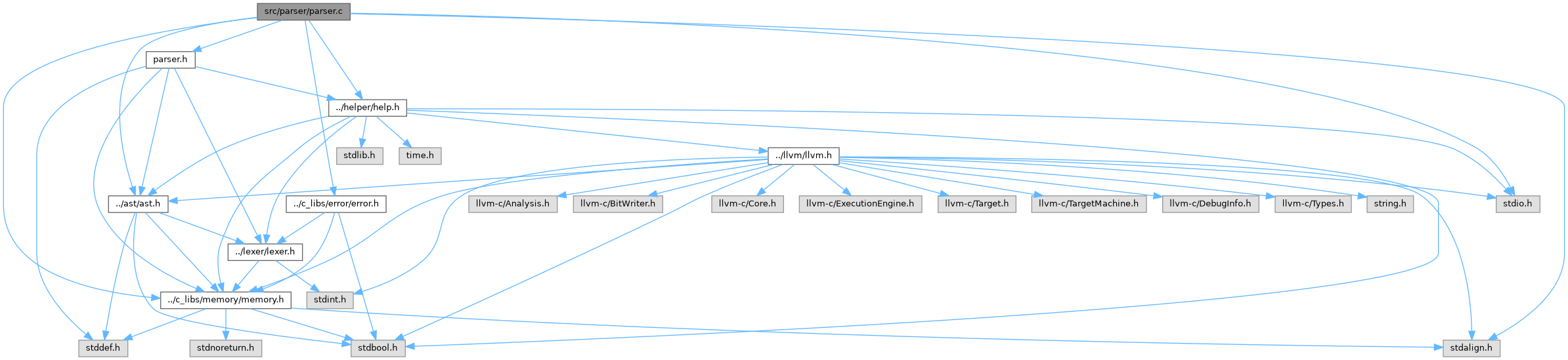
Functions | |
| void | parser_error (Parser *psr, const char *error_type, const char *file, const char *msg, int line, int col, int tk_length) |
| Reports a parser error with detailed location information. | |
| Stmt * | parse (GrowableArray *tks, ArenaAllocator *arena, BuildConfig *config) |
| Main parsing function that converts tokens into an AST. | |
| BindingPower | get_bp (LumaTokenType kind) |
| Gets the binding power (precedence) for a given token type. | |
| Expr * | nud (Parser *parser) |
| Null Denotation - handles prefix expressions and primary expressions. | |
| Expr * | led (Parser *parser, Expr *left, BindingPower bp) |
| Left Denotation - handles binary and postfix expressions. | |
| Expr * | parse_expr (Parser *parser, BindingPower bp) |
| Parses an expression using the Pratt parsing algorithm. | |
| Stmt * | parse_stmt (Parser *parser) |
| Parses a single statement. | |
| Type * | parse_type (Parser *parser) |
| Parses a type annotation. | |
Detailed Description
Implementation of the parser module for the programming language compiler.
This file contains the core parsing functionality that converts a stream of tokens into an Abstract Syntax Tree (AST). The parser uses a Pratt parser approach for handling operator precedence and associativity in expressions.
The parser supports:
- Statement parsing (variables, functions, control flow, etc.)
- Expression parsing with proper operator precedence
- Type parsing for type annotations
- Error reporting with source location information
- Date
- 2025
- Version
- 1.0
Function Documentation
◆ get_bp()
| BindingPower get_bp | ( | LumaTokenType | kind | ) |
Gets the binding power (precedence) for a given token type.
This function is crucial for the Pratt parser implementation. It returns the binding power (precedence level) for different operators, which determines the order of operations during expression parsing.
Higher binding power values indicate higher precedence operators.
- Parameters
-
kind The token type to get binding power for
- Returns
- BindingPower enumeration value representing the precedence level Returns BP_NONE for tokens that don't have binding power
- Note
- Precedence levels (highest to lowest):
- BP_CALL: Function calls, member access, indexing
- BP_POSTFIX: Postfix increment/decrement
- BP_PRODUCT: Multiplication, division
- BP_SUM: Addition, subtraction
- BP_RELATIONAL: Comparison operators
- BP_EQUALITY: Equality and inequality
- BP_BITWISE_AND, BP_BITWISE_XOR, BP_BITWISE_OR: Bitwise operations
- BP_LOGICAL_AND, BP_LOGICAL_OR: Logical operations
- BP_TERNARY: Ternary conditional operator
- BP_ASSIGN: Assignment operators
- See also
- BindingPower, LumaTokenType
◆ led()
| Expr * led | ( | Parser * | parser, |
| Expr * | left, | ||
| BindingPower | bp | ||
| ) |
Left Denotation - handles binary and postfix expressions.
Pratt parser function for left denotation (infix/postfix parsing).
This is part of the Pratt parser implementation. The "led" function handles tokens that can appear after an expression has been parsed (binary operators and postfix operators).
- Parameters
-
parser Pointer to the parser instance left The left operand expression (already parsed) bp The current binding power context
- Returns
- Pointer to the parsed expression AST node incorporating the left operand, or the original left expression if no valid LED is found
- Note
- Handles:
- Binary arithmetic and logical operators: +, -, *, /, ==, !=, etc.
- Function calls: function(args)
- Assignment: variable = value
- Member access: object.member
- Postfix operators: variable++, variable–
- Array indexing: array[index]
- See also
- nud(), parse_expr(), binary(), call_expr(), assign_expr(), prefix_expr()
◆ nud()
Null Denotation - handles prefix expressions and primary expressions.
This is part of the Pratt parser implementation. The "nud" function handles tokens that can appear at the beginning of an expression (prefix operators and primary expressions like literals and identifiers).
- Parameters
-
parser Pointer to the parser instance
- Returns
- Pointer to the parsed expression AST node, or NULL if parsing fails
- Note
- Handles:
- Primary expressions: numbers, strings, identifiers
- Prefix unary operators: -, +, !, ++, –
- Grouped expressions: (expression)
- Array literals: [expression, ...]
- See also
- led(), parse_expr(), primary(), unary(), grouping(), array_expr()
◆ parse()
| Stmt * parse | ( | GrowableArray * | tks, |
| ArenaAllocator * | arena, | ||
| BuildConfig * | config | ||
| ) |
Main parsing function that converts tokens into an AST.
Parses a full program from tokens into an AST of statements.
This is the entry point for the parser. It takes a growable array of tokens and converts them into a complete program AST node containing all parsed statements.
- Parameters
-
tks Growable array containing all tokens from the lexer arena Arena allocator for memory management during parsing
- Returns
- Pointer to the root AST node (Program node) containing all parsed statements, or NULL if parsing fails
- Note
- The function estimates the initial capacity for statements based on token count
- All memory allocations use the provided arena allocator
- See also
- Parser, parse_stmt(), create_program_node()
Main parsing function that converts tokens into an AST
This is the entry point for the parser. It takes a growable array of tokens and converts them into a complete program AST node containing all parsed statements.
◆ parse_expr()
| Expr * parse_expr | ( | Parser * | parser, |
| BindingPower | bp | ||
| ) |
Parses an expression using the Pratt parsing algorithm.
This is the core expression parsing function that implements the Pratt parser algorithm. It handles operator precedence and associativity automatically through the binding power mechanism.
- Parameters
-
parser Pointer to the parser instance bp Minimum binding power - only operators with higher binding power will be consumed by this call
- Returns
- Pointer to the parsed expression AST node, or NULL if parsing fails
- Note
- The algorithm works by:
- See also
- nud(), led(), get_bp(), BindingPower
◆ parse_stmt()
Parses a single statement.
This function dispatches to the appropriate statement parsing function based on the current token. It also handles visibility modifiers (public/private) that can appear before certain statement types.
- Parameters
-
parser Pointer to the parser instance
- Returns
- Pointer to the parsed statement AST node, or NULL if parsing fails
- Note
- Handles:
- Variable declarations: const, var
- Control flow: return, if, loop, break, continue
- Block statements: { ... }
- Print statements: print, println
- Expression statements: any expression followed by semicolon
- Visibility modifiers: public, private (applied to declarations)
◆ parse_type()
Parses a type annotation.
This function parses type expressions used in variable declarations, function parameters, return types, etc. It handles primitive types, pointer types, array types, and user-defined types.
- Parameters
-
parser Pointer to the parser instance
- Returns
- Pointer to the parsed Type AST node, or NULL if parsing fails
- Note
- Handles:
- Primitive types: int, uint, float, bool, string, void, char
- Pointer types: *type
- Array types: [size]type or []type
- User-defined types: identified by TOK_IDENTIFIER
- Warning
- Prints error message to stderr for unexpected tokens
- See also
- tnud(), tled(), LumaTokenType
◆ parser_error()
| void parser_error | ( | Parser * | psr, |
| const char * | error_type, | ||
| const char * | file, | ||
| const char * | msg, | ||
| int | line, | ||
| int | col, | ||
| int | tk_length | ||
| ) |
Reports a parser error with detailed location information.
Report a parser error with detailed location info.
Creates and adds an error to the global error system with information about where the error occurred in the source code, including line and column information.
- Parameters
-
psr Pointer to the parser instance error_type String describing the type of error (e.g., "SyntaxError") file Path to the source file where the error occurred msg Detailed error message describing what went wrong line Line number where the error occurred (1-based) col Column number where the error occurred (1-based) tk_length Length of the token that caused the error
- Note
- This function uses the arena allocator to duplicate the line text
- See also
- ErrorInformation, error_add()