Statement parsing implementation for the programming language compiler. More...
#include <stdio.h>#include <string.h>#include "../ast/ast.h"#include "parser.h"#include "src/lexer/lexer.h"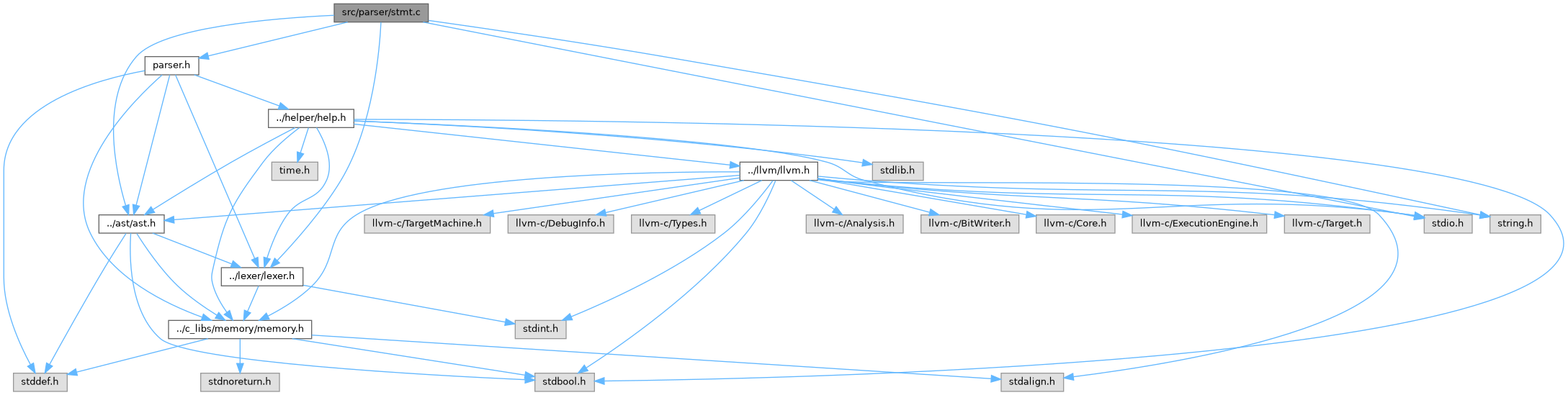
Functions | |
| Stmt * | expr_stmt (Parser *parser) |
| Parses an expression statement. | |
| Stmt * | use_stmt (Parser *parser) |
| Stmt * | os_stmt (Parser *parser) |
| Stmt * | link_stmt (Parser *parser) |
| Stmt * | const_stmt (Parser *parser, bool is_public, bool returns_ownership, bool takes_ownership) |
| Parses a constant declaration statement. | |
| Stmt * | fn_stmt (Parser *parser, const char *name, bool is_public, bool is_static, bool returns_ownership, bool takes_ownership) |
| Parses a function declaration statement. | |
| Stmt * | enum_stmt (Parser *parser, const char *name, bool is_public) |
| Parses an enumeration declaration statement. | |
| Stmt * | struct_stmt (Parser *parser, const char *name, bool is_public) |
| Parses a structure declaration statement. | |
| Stmt * | var_stmt (Parser *parser, bool is_public) |
| Parses a variable declaration statement. | |
| Stmt * | return_stmt (Parser *parser) |
| Parses a return statement. | |
| Stmt * | block_stmt (Parser *parser) |
| Parses a block statement. | |
| Stmt * | if_stmt (Parser *parser) |
| Parses if/elif/else conditional statements. | |
| Stmt * | infinite_loop_stmt (Parser *parser, int line, int col) |
| Parses an infinite loop statement. | |
| Stmt * | loop_init (Parser *parser, int line, int col) |
| Parses a loop initializer declaration. | |
| Stmt * | for_loop_stmt (Parser *parser, int line, int col) |
| Parses a for loop statement. | |
| Stmt * | loop_stmt (Parser *parser) |
| Parses loop statements (infinite, while, or for loops) | |
| Stmt * | print_stmt (Parser *parser, bool ln) |
| Parses print/println statements. | |
| Stmt * | break_continue_stmt (Parser *parser, bool is_continue) |
| Parses break and continue statements. | |
| Stmt * | defer_stmt (Parser *parser) |
| Stmt * | switch_stmt (Parser *parser) |
| Stmt * | impl_stmt (Parser *parser) |
Detailed Description
Statement parsing implementation for the programming language compiler.
This file contains implementations for parsing all types of statements in the programming language, including declarations, control flow statements, and compound statements. Each parsing function is responsible for consuming the appropriate tokens and constructing the corresponding AST nodes.
Supported statement types:
- Expression statements
- Variable and constant declarations (with optional type annotations)
- Function declarations with parameters and return types
- Struct and enum declarations with member visibility
- Control flow: if/elif/else, loops (infinite, while, for), return
- Block statements and compound statements
- Print statements for output
- Break and continue statements for loop control
- Date
- 2025
- Version
- 1.0
Function Documentation
◆ block_stmt()
Parses a block statement.
Handles block statements with the syntax: { statement1; statement2; ... }
- Parameters
-
parser Pointer to the parser instance
- Returns
- Pointer to the block statement AST node, or NULL on failure
- Note
- Empty blocks are allowed and create a valid block statement with 0 statements
- Each statement in the block is parsed recursively using parse_stmt()
- Handles memory allocation for the statement array using growable arrays
- Continues parsing on individual statement failures (for error recovery)
- See also
- parse_stmt(), create_block_stmt()
◆ break_continue_stmt()
Parses break and continue statements.
Handles loop control statements with the syntax:
break;- Exit the current loopcontinue;- Skip to the next iteration of the current loop
- Parameters
-
parser Pointer to the parser instance is_continue Whether this is a continue (true) or break (false) statement
- Returns
- Pointer to the break/continue statement AST node, or NULL on failure
- Note
- Both statements require semicolon terminators
- These statements are only valid within loop contexts (enforced at semantic analysis)
- Break exits the innermost enclosing loop
- Continue skips to the next iteration of the innermost enclosing loop
- See also
- create_break_continue_stmt()
◆ const_stmt()
Parses a constant declaration statement.
Handles multiple forms of constant declarations:
const name: Type = value;- Explicit type annotationconst name = fn ...- Function declarationconst name = struct ...- Struct declarationconst name = enum ...- Enum declaration
- Parameters
-
parser Pointer to the parser instance is_public Whether this declaration has public visibility
- Returns
- Pointer to the appropriate declaration statement AST node, or NULL on failure
- Note
- For simple constants, creates a variable declaration with immutable flag
- For complex types (functions, structs, enums), delegates to specialized parsers
- If no type is specified, it defaults to the type of the value
- See also
- fn_stmt(), struct_stmt(), enum_stmt(), create_var_decl_stmt()
◆ defer_stmt()
◆ enum_stmt()
Parses an enumeration declaration statement.
Handles enum declarations with the syntax: enum { member1, member2, member3, ... };
- Parameters
-
parser Pointer to the parser instance name Enum name (already parsed by caller) is_public Whether this enum has public visibility
- Returns
- Pointer to the enum declaration AST node, or NULL on failure
- Note
- Enum members are identifiers separated by commas
- Trailing commas are allowed but not required
- Requires a semicolon terminator after the closing brace
- See also
- create_enum_decl_stmt()
◆ expr_stmt()
Parses an expression statement.
An expression statement consists of any expression followed by a semicolon. This is used for statements that evaluate an expression for its side effects, such as function calls or assignment expressions.
- Parameters
-
parser Pointer to the parser instance
- Returns
- Pointer to the created expression statement AST node, or NULL on failure
- Note
- Captures line and column information at the start of parsing
- Requires a semicolon terminator
- See also
- parse_expr(), create_expr_stmt()
◆ fn_stmt()
| Stmt * fn_stmt | ( | Parser * | parser, |
| const char * | name, | ||
| bool | is_public, | ||
| bool | is_static, | ||
| bool | returns_ownership, | ||
| bool | takes_ownership | ||
| ) |
Parses a function declaration statement.
Handles function declarations with the syntax: fn(param1: Type1, param2: Type2, ...) ReturnType { body }
- Parameters
-
parser Pointer to the parser instance name Function name (already parsed by caller) is_public Whether this function has public visibility
- Returns
- Pointer to the function declaration AST node, or NULL on failure
- Note
- Function parameters are stored as parallel arrays of names and types
- Return type is required and parsed after the parameter list
- Function body must be a block statement
- Memory for parameter arrays is allocated using the arena allocator
- See also
- parse_type(), block_stmt(), create_func_decl_stmt()
◆ for_loop_stmt()
Parses a for loop statement.
Handles for loops with the syntax:
- Parameters
-
parser Pointer to the parser instance line Line number where the loop statement starts col Column number where the loop statement starts
- Returns
- Pointer to the for loop statement AST node, or NULL on failure
- Note
- Supports multiple initializer variables separated by commas
- Main condition is required and parenthesized
- Optional secondary condition can be provided after a colon
- Loop body must be a block statement
◆ if_stmt()
Parses if/elif/else conditional statements.
Handles complex conditional statements with multiple branches:
- Parameters
-
parser Pointer to the parser instance
- Returns
- Pointer to the if statement AST node, or NULL on failure
- Note
- Supports multiple elif clauses
- Else clause is optional
- Each condition must be parenthesized
- Each branch must be a block statement
- Elif statements are collected in an array rather than nested recursively
- See also
- parse_expr(), block_stmt(), create_if_stmt()
◆ impl_stmt()
◆ infinite_loop_stmt()
Parses an infinite loop statement.
Handles infinite loops with the syntax: loop { ... }
- Parameters
-
parser Pointer to the parser instance line Line number where the loop statement starts col Column number where the loop statement starts
- Returns
- Pointer to the infinite loop statement AST node, or NULL on failure
- Note
- The loop body must be a block statement
- This creates a loop that runs indefinitely unless broken by break/return
- See also
- block_stmt(), create_infinite_loop_stmt()
◆ link_stmt()
◆ loop_init()
Parses a loop initializer declaration.
Helper function for parsing variable declarations within for-loop initializers. Handles the syntax: name: Type = expression
- Parameters
-
parser Pointer to the parser instance line Line number for the declaration col Column number for the declaration
- Returns
- Pointer to the variable declaration statement, or NULL on failure
- Note
- Creates a mutable, non-public variable declaration
- Used exclusively within for-loop initializer lists
- See also
- create_var_decl_stmt()
◆ loop_stmt()
Parses loop statements (infinite, while, or for loops)
Dispatcher function that determines the type of loop based on the following tokens and delegates to the appropriate specialized parser:
loop { ... }→ infinite looploop [initializers](...) { ... }→ for looploop (condition) { ... }→ while looploop (condition) : (optional_condition) { ... }→ while loop with secondary condition
- Parameters
-
parser Pointer to the parser instance
- Returns
- Pointer to the appropriate loop statement AST node, or NULL on failure
- Note
- The specific loop type is determined by the token following 'loop'
- All loop bodies must be block statements
◆ os_stmt()
◆ print_stmt()
Parses print/println statements.
Handles output statements with the syntax:
print(expr1, expr2, ...);println(expr1, expr2, ...);
- Parameters
-
parser Pointer to the parser instance ln Whether this is a println (true) or print (false) statement
- Returns
- Pointer to the print statement AST node, or NULL on failure
- Note
- Supports multiple expressions separated by commas
- println automatically adds a newline after output
-
Empty argument lists are allowed:
print(); - All expressions are evaluated and their values are printed
- See also
- parse_expr(), create_print_stmt()
◆ return_stmt()
Parses a return statement.
Handles return statements with optional return values:
return;- Return with no value (void return)return expression;- Return with a value
- Parameters
-
parser Pointer to the parser instance
- Returns
- Pointer to the return statement AST node, or NULL on failure
- Note
- The return value is optional; if not present, creates a void return
- Requires a semicolon terminator
- See also
- parse_expr(), create_return_stmt()
◆ struct_stmt()
Parses a structure declaration statement.
Handles struct declarations with public/private member visibility:
- Parameters
-
parser Pointer to the parser instance name Struct name (already parsed by caller) is_public Whether this struct has public visibility
- Returns
- Pointer to the struct declaration AST node, or NULL on failure
- Note
- Members are separated into public and private arrays
- Supports both data fields (name: Type) and methods (name = fn ...)
- Visibility defaults to public unless explicitly changed
- Visibility changes affect all subsequent members until changed again
◆ switch_stmt()
◆ use_stmt()
◆ var_stmt()
Parses a variable declaration statement.
Handles variable declarations with the syntax: var name: Type = value;
- Parameters
-
parser Pointer to the parser instance is_public Whether this variable has public visibility
- Returns
- Pointer to the variable declaration AST node, or NULL on failure
- Note
- Variables are mutable by default (unlike constants)
- Type annotation is required
- Initial value assignment is required
- Creates a variable declaration with is_mutable set to true
- See also
- parse_type(), parse_expr(), create_var_decl_stmt()