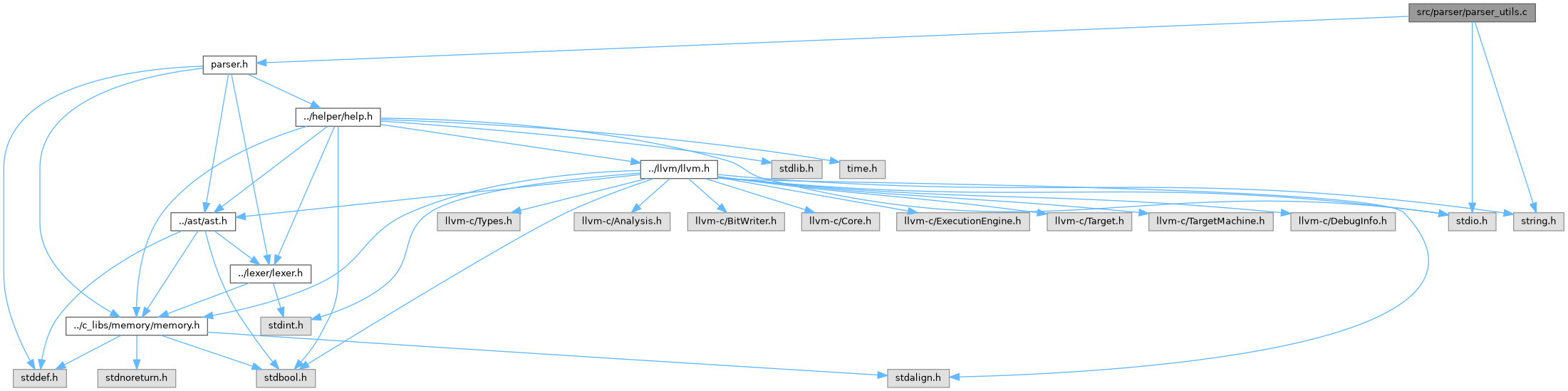
Utility functions for the parser module. More...
Functions | |
| bool | p_has_tokens (Parser *psr) |
| Checks if there are more tokens available for parsing. | |
| Token | p_peek (Parser *psr, size_t offset) |
| Peeks at a token at the specified offset from current position. | |
| Token | p_current (Parser *psr) |
| Gets the current token without advancing the parser position. | |
| Token | p_advance (Parser *psr) |
| Advances to the next token and returns the current token. | |
| Token | p_consume (Parser *psr, LumaTokenType type, const char *error_msg) |
| Consumes a token of the expected type or reports an error. | |
| char * | get_name (Parser *psr) |
| Extracts and duplicates the current token's string value. | |
| bool | init_parser_arrays (Parser *parser, GrowableArray *stmts, GrowableArray *modules) |
| const char * | parse_module_declaration (Parser *parser, char **out_module_doc) |
| char * | collect_doc_comments (Parser *parser) |
| Collects consecutive documentation comments before a declaration. | |
| void | consume_doc_comments (Parser *parser) |
Detailed Description
Utility functions for the parser module.
This file contains essential utility functions that provide the core infrastructure for token navigation and manipulation during parsing. These functions abstract the low-level details of token stream management and provide a clean interface for parser operations.
The utilities include:
- Token stream navigation (current, peek, advance)
- Token consumption with error reporting
- Token validation and bounds checking
- String extraction and memory management for identifiers
All functions are designed to be safe and handle edge cases like end-of-stream conditions gracefully by returning EOF tokens.
- Date
- [Current Date]
- Version
- 1.0
Function Documentation
◆ collect_doc_comments()
| char * collect_doc_comments | ( | Parser * | parser | ) |
Collects consecutive documentation comments before a declaration.
Accumulates all doc comments (/// or //!) that appear immediately before the current token. Returns them as a single string with newlines preserved.
- Parameters
-
parser Pointer to the parser instance
- Returns
- Concatenated doc comment string, or NULL if no doc comments found
◆ consume_doc_comments()
| void consume_doc_comments | ( | Parser * | parser | ) |
◆ get_name()
| char * get_name | ( | Parser * | psr | ) |
Extracts and duplicates the current token's string value.
This function creates a null-terminated string copy of the current token's value using the arena allocator. It's primarily used for extracting identifier names, string literals, and other textual token content that needs to be preserved in the AST.
- Parameters
-
psr Pointer to the parser instance
- Returns
- Pointer to a null-terminated string containing the current token's value, allocated using the parser's arena allocator
- Note
- The returned string is allocated using arena_alloc() for automatic memory management
- The string is properly null-terminated for safe use with standard string functions
- The original token value is copied, so the returned string is independent
- Memory is automatically managed by the arena - no manual deallocation needed
- Warning
- This function assumes the current token has a valid value field
- Should only be called when you know the current token contains string data
◆ init_parser_arrays()
| bool init_parser_arrays | ( | Parser * | parser, |
| GrowableArray * | stmts, | ||
| GrowableArray * | modules | ||
| ) |
◆ p_advance()
Advances to the next token and returns the current token.
This function moves the parser position forward by one token and returns the token that was current before advancing. This is the primary mechanism for consuming tokens during parsing.
- Parameters
-
psr Pointer to the parser instance
- Returns
- The token that was current before advancing, or EOF token if already at the end of the token stream
- Note
- The parser position is incremented only if there are tokens available
- Safe to call at end of stream - returns EOF token and doesn't advance
- This is a mutating operation that changes parser state
- Warning
- After calling this function, subsequent calls to p_current() will return the next token in the stream
- See also
- p_current(), p_has_tokens(), p_consume()
◆ p_consume()
| Token p_consume | ( | Parser * | psr, |
| LumaTokenType | type, | ||
| const char * | error_msg | ||
| ) |
Consumes a token of the expected type or reports an error.
This function is used when the parser expects a specific token type at the current position. If the current token matches the expected type, it advances and returns the token. If not, it reports a syntax error with the provided error message.
- Parameters
-
psr Pointer to the parser instance type The expected token type that should be at the current position error_msg Error message to display if the token doesn't match
- Returns
- The consumed token if it matches the expected type, or an EOF token if there's a mismatch (indicating an error)
- Note
- This function combines token validation and consumption in one operation
- Error reporting includes current line, column, and token length information
- The parser position advances only on successful token match
- On error, the parser position remains unchanged
- Warning
- Always check the return value's type if you need to handle parsing errors
- See also
- p_current(), p_advance(), parser_error(), LumaTokenType
◆ p_current()
Gets the current token without advancing the parser position.
This function returns the token at the current parser position without modifying the parser state. It's the most frequently used function for examining the current token during parsing.
- Parameters
-
psr Pointer to the parser instance
- Returns
- Current token, or an EOF token if at the end of the token stream
- Note
- This function is safe to call even when at the end of the token stream
- The returned token contains all token information: type, value, position, etc.
- Does not modify parser state - can be called multiple times safely
- See also
- p_advance(), p_peek(), Token
◆ p_has_tokens()
| bool p_has_tokens | ( | Parser * | psr | ) |
Checks if there are more tokens available for parsing.
This function determines whether the parser has reached the end of the token stream. It's used throughout the parser to control parsing loops and prevent buffer overruns when accessing tokens.
- Parameters
-
psr Pointer to the parser instance
- Returns
- true if there are more tokens to process (and current token is not EOF), false if at end of stream or current token is EOF
- Note
- This function performs two checks:
- Position is within the token array bounds
- Current token is not TOK_EOF (which marks end of input)
- See also
- p_current(), p_advance()
◆ p_peek()
Peeks at a token at the specified offset from current position.
This function allows looking ahead in the token stream without advancing the current position. It's useful for making parsing decisions based on upcoming tokens (lookahead parsing).
- Parameters
-
psr Pointer to the parser instance offset Number of positions ahead to look (0 = current, 1 = next, etc.)
- Returns
- Token at the specified offset, or an EOF token if the offset goes beyond the end of the token stream
- Note
- Common usage patterns:
p_peek(parser, 0)is equivalent top_current(parser)p_peek(parser, 1)looks at the next token- Safe to use with any offset; returns EOF token for out-of-bounds access
- See also
- p_current(), Token, TOK_EOF
◆ parse_module_declaration()
| const char * parse_module_declaration | ( | Parser * | parser, |
| char ** | out_module_doc | ||
| ) |