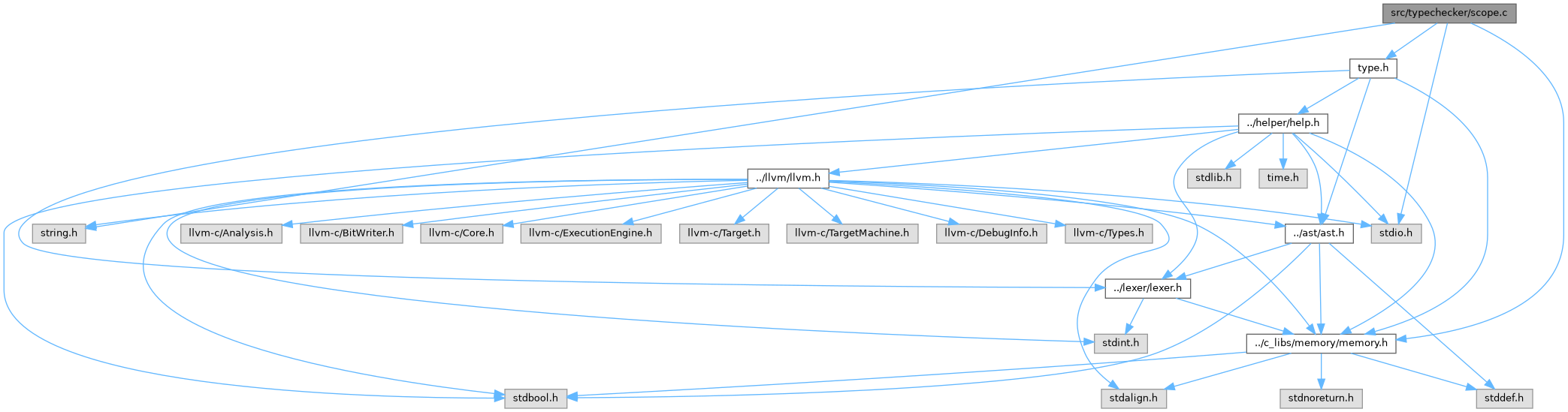
Implementation of scope and symbol table management functions. More...
Functions | |
| void | init_scope (Scope *scope, Scope *parent, const char *name, ArenaAllocator *arena) |
| Initialize a scope structure with enhanced metadata. | |
| Symbol * | scope_lookup_with_visibility (Scope *scope, const char *name, Scope *requesting_module_scope) |
| const char * | get_current_function_name (Scope *scope) |
| bool | scope_add_symbol_with_ownership (Scope *scope, const char *name, AstNode *type, bool is_public, bool is_mutable, bool returns_ownership, bool takes_ownership, ArenaAllocator *arena) |
| bool | scope_add_symbol (Scope *scope, const char *name, AstNode *type, bool is_public, bool is_mutable, ArenaAllocator *arena) |
| Scope * | find_containing_module (Scope *scope) |
| Find the containing module scope for a given scope. | |
| Symbol * | scope_lookup (Scope *scope, const char *name) |
| Original scope_lookup - now wraps the visibility version. | |
| Symbol * | scope_lookup_current_only_with_visibility (Scope *scope, const char *name, Scope *requesting_module_scope) |
| Look up a symbol only in the current scope with visibility rules. | |
| Symbol * | scope_lookup_current_only (Scope *scope, const char *name) |
| Original scope_lookup_current_only - now wraps the visibility version. | |
| Scope * | create_child_scope (Scope *parent, const char *name, ArenaAllocator *arena) |
| Create a new child scope under the specified parent. | |
Detailed Description
Implementation of scope and symbol table management functions.
This file contains the implementation of the hierarchical scope system for symbol table management. It provides functionality for creating, managing, and searching through nested scopes with proper parent-child relationships and symbol resolution.
The scope system supports:
- Hierarchical scope creation with automatic depth tracking
- Symbol addition with duplicate detection
- Multi-level symbol lookup with parent traversal
- Automatic parent-child relationship management
Function Documentation
◆ create_child_scope()
| Scope * create_child_scope | ( | Scope * | parent, |
| const char * | name, | ||
| ArenaAllocator * | arena | ||
| ) |
Create a new child scope under the specified parent.
Allocates and initializes a new scope as a child of the given parent, automatically establishing the parent-child relationship and adding the new scope to the parent's children list.
- Parameters
-
parent Parent scope for the new child (NULL for root scope) name Descriptive name for the new scope arena Arena allocator for memory management
- Returns
- Pointer to the newly created and initialized child scope
Creation process:
- Allocate memory for new Scope structure from arena
- Initialize the scope with proper parent linkage
- Add the new scope to parent's children array (if parent exists)
- Return pointer to fully initialized child scope
- Note
- The child scope is automatically added to the parent's children list, maintaining the bidirectional parent-child relationship for debugging and traversal purposes
- Warning
- If memory allocation fails, this function may return NULL or an incompletely initialized scope. The caller should verify successful creation before using the returned scope.
- If adding the child to the parent's children array fails due to memory constraints, the child scope will still be created and functional, but won't appear in the parent's children list.
◆ find_containing_module()
◆ get_current_function_name()
| const char * get_current_function_name | ( | Scope * | scope | ) |
◆ init_scope()
| void init_scope | ( | Scope * | scope, |
| Scope * | parent, | ||
| const char * | name, | ||
| ArenaAllocator * | arena | ||
| ) |
Initialize a scope structure with enhanced metadata.
Sets up a new scope with proper initialization of all fields, including parent-child relationships, depth calculation, and growable arrays for symbols and children. The scope is fully prepared for symbol addition and child scope creation.
- Parameters
-
scope Pointer to the scope structure to initialize (must be pre-allocated) parent Parent scope for hierarchical lookup (NULL for global scope) name Descriptive name for debugging and identification (NULL becomes "unnamed") arena Arena allocator for all memory allocations within this scope
Initialization includes:
- Parent pointer assignment and depth calculation
- Name duplication into arena memory for persistence
- Default flag initialization (not a function scope, no associated AST node)
- Growable array setup with reasonable initial capacities (16 symbols, 8 children)
- Note
- The scope name is duplicated using arena allocation, ensuring it remains valid for the lifetime of the scope without external string management
- Warning
- The scope parameter must point to valid, allocated memory. This function does not allocate the scope structure itself, only initializes it.
◆ scope_add_symbol()
| bool scope_add_symbol | ( | Scope * | scope, |
| const char * | name, | ||
| AstNode * | type, | ||
| bool | is_public, | ||
| bool | is_mutable, | ||
| ArenaAllocator * | arena | ||
| ) |
◆ scope_add_symbol_with_ownership()
| bool scope_add_symbol_with_ownership | ( | Scope * | scope, |
| const char * | name, | ||
| AstNode * | type, | ||
| bool | is_public, | ||
| bool | is_mutable, | ||
| bool | returns_ownership, | ||
| bool | takes_ownership, | ||
| ArenaAllocator * | arena | ||
| ) |
◆ scope_lookup()
Original scope_lookup - now wraps the visibility version.
◆ scope_lookup_current_only()
Original scope_lookup_current_only - now wraps the visibility version.
◆ scope_lookup_current_only_with_visibility()
| Symbol * scope_lookup_current_only_with_visibility | ( | Scope * | scope, |
| const char * | name, | ||
| Scope * | requesting_module_scope | ||
| ) |
Look up a symbol only in the current scope with visibility rules.